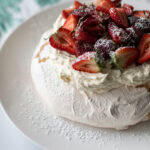
Perfect Pavlova Recipe (Foolproof Australian Pavlova Base)
My most trusted pavlova recipe, taught in countless classes and loved for its crisp exterior and marshmallow-soft centre. Simple, reliable and perfect for celebrations.
Print
Pin
Servings: 8
Cost: 10
Equipment
- Electric mixer (stand mixer or hand-held)
- Large mixing bowl (scrupulously clean and dry)
- Rubber spatula or large metal spoon
- Baking tray
- Baking paper
- 24 cm circle template (plate or cake tin base)
- Oven
Ingredients
- 6 egg whites at room temperature
- 300 g caster sugar
- Pinch of fine sea salt optional
- ½ teaspoon cream of tartar
- 2 teaspoons cornflour
- 1 teaspoon white vinegar
- 1 teaspoon vanilla bean paste or vanilla extract
- To serve:
- Assorted fresh berries
- 600 ml thickened cream option to mix in 300 ml of mascarpone
- 1-2 tablespoons icing sugar optional
- Fresh thyme or mint leaves
- Icing sugar for dusting
Instructions
- Preheat your oven to 180°C (fan).
- Draw a 24 cm circle on baking paper, place on a baking tray, and lightly mist with oil.
- Note - Once the pavlova goes in the oven, you will immediately reduce the temperature to 110°C fan (130°C conventional). Do not skip the high preheat — it helps set the exterior.
- Ensure your bowl and whisk are completely clean and dry. Even a trace of fat prevents the whites from whipping properly.
- Add the egg whites, cream of tartar and a pinch of salt to the bowl.
- Beat on medium speed for 30 seconds, then increase to medium–high until soft peaks form (about 5 minutes).
- Soft peaks create the right structure for the sugar to dissolve properly.
- With the mixer running on medium speed, add the caster sugar 1–2 tablespoons at a time. Do not increase the speed yet — high speed prevents sugar dissolving properly.
- Once all the sugar has been added, increase to high speed and beat until the mixture is thick, glossy and holds stiff peaks that curl at the tip.
- Rub a little meringue between your fingers — it should feel completely smooth with no sugar grains.
- Sprinkle over the cornflour, vinegar and vanilla.
- Whisk slowly and briefly (5–10 seconds) to incorporate.
- Spoon the meringue onto your prepared tray within the drawn circle.
- Shape it into a tall disc, keeping the sides slightly higher than the centre. This creates a generous well for cream when serving.
- Place the pavlova in the oven and immediately reduce the temperature to 110°C fan (130°C conventional).
- Bake for 90 minutes. If the pavlova starts to colour, reduce the oven temperature by 10°C.
- Cool slowly (most important step)
- Turn the oven off and leave the pavlova inside without opening the door.
- Allow it to cool completely for at least 5 hours or overnight.
- Slow cooling prevents cracking, collapse and weeping.
- Whip the 600 ml of cream to soft peaks. Over whipped cream splits quickly on warm days. You could add a tablespoon or two of sifted icing sugar for sweetness if you wish to (I do). I love the addition of mascarpone – which I stir through the whipped cream but 600 ml of whipped cream on it’s own is also perfect.
- Spoon the pav generously with the whipped cream. You may not need it all and reserved cream can be served alongside.
- Add the berries.
- Finish with fresh thyme or mint and a dusting of icing sugar.
Notes
Notes
Use the freshest eggs you can. Fresh whites whip tighter and form a stronger structure.
Moisture is the enemy. If humidity is high, turn on the air conditioner or bake at a drier time of day.
Do not over-whip the egg whites. Over-whipped whites look fluffy but collapse in the oven.
Pavlova improves with resting. The texture becomes even more marshmallowy after several hours of cooling.
Storage
Store the unfilled pavlova in an airtight container.
Keep it in a cool, dry place — never the fridge.
Best enjoyed within 24–48 hours of baking.
FAQ
Why did my pavlova collapse?
Over-whipping, adding sugar too quickly, or opening the oven too early can cause collapse. Why does my pavlova weep?
The sugar was not fully dissolved or the weather was humid. Why isn’t my pavlova white?
Your oven may have been too hot. Reduce the temperature by 10°C next time. How do I stop it cracking?
Cracking comes from sudden temperature changes.
Avoid opening the oven, keep drafts away, and allow it to cool slowly and fully. Can I freeze pavlova?
No. Freezing damages the delicate structure and causes weeping when thawed.
Over-whipping, adding sugar too quickly, or opening the oven too early can cause collapse. Why does my pavlova weep?
The sugar was not fully dissolved or the weather was humid. Why isn’t my pavlova white?
Your oven may have been too hot. Reduce the temperature by 10°C next time. How do I stop it cracking?
Cracking comes from sudden temperature changes.
Avoid opening the oven, keep drafts away, and allow it to cool slowly and fully. Can I freeze pavlova?
No. Freezing damages the delicate structure and causes weeping when thawed.